10kW Solar System Price in Pakistan (2026): Three-Phase Cost, Units Generated & Sizing
Technically Reviewed by Engr. Muhammad Naeem · Last Updated: 2026
Key Takeaway (AEO Direct Answer)
In 2026, a 10kW on-grid solar system in Pakistan costs between Rs. 1,050,000 and Rs. 1,250,000 turnkey with green meter licensing, while a 10kW hybrid system with 10kWh LiFePO4 battery storage costs Rs. 1.55M to Rs. 1.85M. It generates 1,350 to 1,550 monthly summer units, powering three 1.5-ton ACs.
1. The 10kW Benchmark: The Gold Standard for 1-Kanal Pakistani Homes
In Pakistan's residential architecture, the 10kW solar system represents the undisputed gold standard for luxury 1-kanal residences, large joint-family homes, and mid-sized commercial establishments. With escalating utility tariffs under IMF structural stabilization programs pushing residential bills above Rs. 100,000 for monthly consumption exceeding 1,200 units across LESCO, MEPCO, IESCO, and FESCO, installing a 10kW three-phase solar array is the ultimate financial hedge against power sector inflation.
A properly engineered 10kW system generates between 1,350 and 1,550 kilowatt-hours (units) per month during summer peak irradiance, easily running three 1.5-ton inverter air conditioners simultaneously while completely covering general household baseline loads (refrigerators, deep freezers, washing machines, domestic water pumps, and lighting). With wholesale equipment prices stabilizing in 2026, a 10kW on-grid turnkey system achieves full financial payback in just 1.8 to 2.4 years.
2. Complete Itemized 10kW Bill of Materials (On-Grid vs Hybrid 2026)
The table below provides a comprehensive, field-verified engineering bill of materials detailing exact component costs for both an On-Grid Net-Metered setup and a Hybrid Energy Storage configuration equipped with high-voltage Lithium Iron Phosphate (LiFePO4) storage.
| System Component | Engineering Specification | On-Grid Turnkey (PKR) | Hybrid Storage Turnkey (PKR) |
|---|---|---|---|
| Solar PV Array (11.7kWp) | 20x 585W N-Type TOPCon Bifacial (Grade-A) | Rs. 445,000 – 470,000 | Rs. 445,000 – 470,000 |
| Three-Phase Inverter | 10kW Three-Phase (GoodWe / Solis / Inverex Nitrox) | Rs. 280,000 – 315,000 | Rs. 460,000 – 510,000 |
| Battery Storage Bank | 10.24 kWh LiFePO4 (2x 48V 100Ah Rack Modules) | Not Applicable | Rs. 520,000 – 580,000 |
| Mounting Structure | 14-Gauge Hot-Dipped GI (L2 / L3 or Custom Elevated) | Rs. 95,000 – 125,000 | Rs. 95,000 – 125,000 |
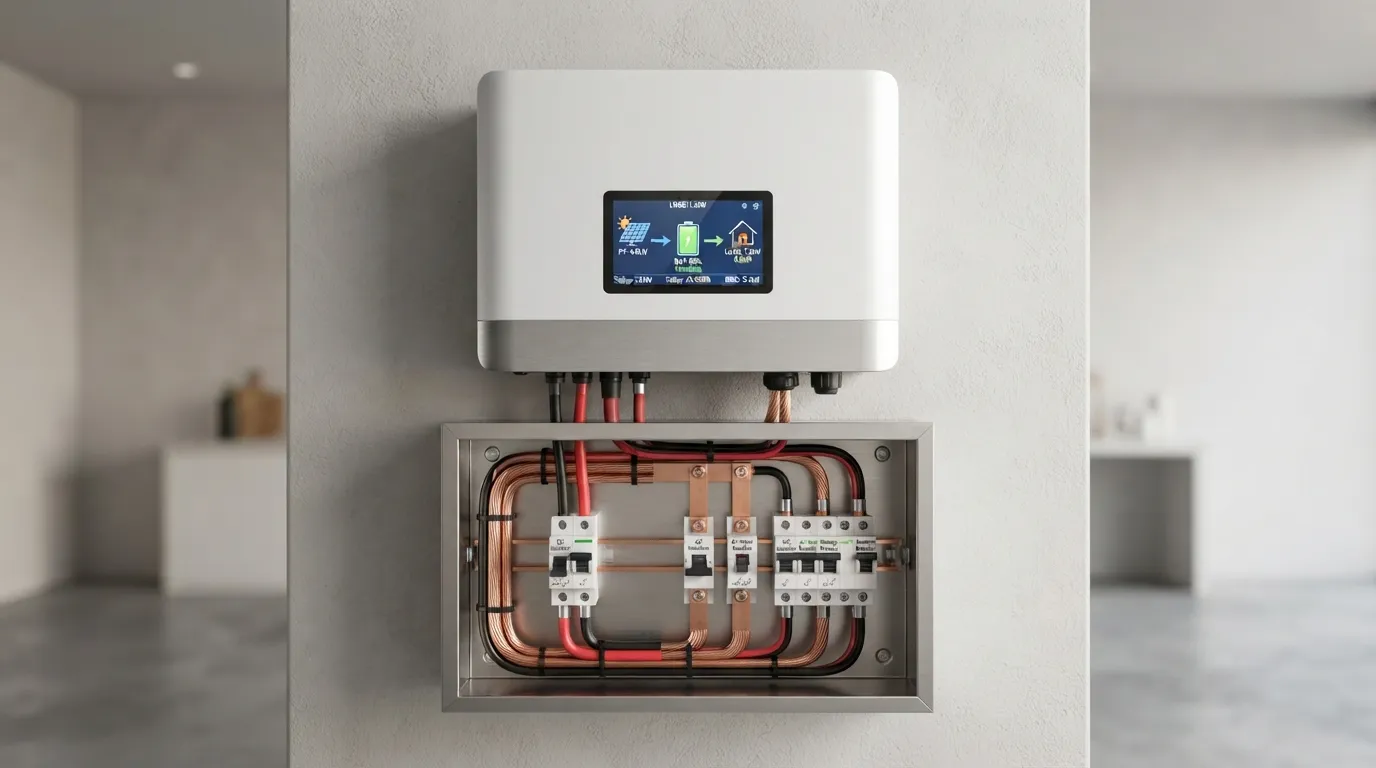
| Electrical Switchgear & DC Cable | Type-2 DC/AC SPDs, Schneider Breakers, 6mm² Cable | Rs. 85,000 – 105,000 | Rs. 105,000 – 130,000 |
| Civil Pedestals & Earth Pits | Concrete Civil Blocks & Dual Chemical Earth Bores (<5Ω) | Rs. 55,000 – 70,000 | Rs. 55,000 – 70,000 |
| Net Metering Licensing (DISCO) | Three-Phase Green Meter, Testing & NEPRA NOC | Rs. 90,000 – 110,000 | Rs. 90,000 – 110,000 |
| Total Turnkey Cost (2026 PKR) | Rs. 1,050,000 – 1,250,000 | Rs. 1,550,000 – 1,850,000 | |
3. Seasonal Unit Generation Profile: Summer Peaks vs Winter Smog
Solar generation in Pakistan exhibits strong seasonal variation that must be factored into household energy budgeting. A 10kW array (utilizing 11.7kWp of DC panels with 1.17x DC-to-AC oversizing) behaves across the four distinct Pakistani seasons as follows:
- Summer Peak (May to August): Generates 48 to 56 kilowatt-hours (units) daily, yielding 1,400 to 1,550 units per month. This perfectly coincides with intense air conditioning demand, allowing homeowners to run multiple ACs with zero grid dependency.
- Autumn Transition (September to October): Excellent clear skies with generation averaging 42 to 46 units daily (1,250 to 1,380 units/month). As AC demand tapers off, massive net energy export is pushed to the grid, banking credits for winter.
- Winter Smog Season (November to January in Punjab): Persistent aerosol smog, fog, and low sun angles depress Global Horizontal Irradiance (GHI). Generation drops to 26 to 34 units daily (800 to 950 units/month). The accumulated financial credits banked during autumn offset winter grid imports.
- Spring Resurgence (February to April): Ideal solar generation conditions with mild ambient temperatures and high irradiance. Daily output surges to 45 to 50 units daily (1,300 to 1,450 units/month).
4. Appliance Load Capacity: Running 3 Inverter Air Conditioners
A 10kW three-phase inverter delivers a continuous AC power output of 10,000 Watts (10kW) with a transient surge capacity exceeding 15kW for 10 seconds. This massive power capacity comfortably handles the following demanding simultaneous residential load profile:
- 3x 1.5-Ton Inverter Air Conditioners: Each unit draws 1,500W to 1,800W during startup, settling to 800W–1,000W running. Total continuous AC demand = 2,700W to 3,200W.
- 1x 1.5 HP Submersible Domestic Water Pump: Draws approximately 1,200W running. Can be operated simultaneously during midday hours.
- 2x Large Inverter Refrigerators + 1x Deep Freezer: Combined steady draw of 450W to 600W.
- 8 to 10 DC Inverter Ceiling Fans + 30 LED Lights: Baseline household draw of ~600W.
- Surplus Generation: Even with all three 1.5-ton ACs, the water pump, and appliances operating simultaneously (total load ~5,500W to 6,000W), the 10kW solar system continues exporting a surplus of 3,500W to 4,500W directly into the utility grid!
5. Rooftop Space & Structural Civil Engineering (650–750 Sq. Ft.)
A 10kW solar system uses twenty modern 585W N-Type TOPCon panels (dimensions: 2.27m × 1.13m each, covering ~2.57 square meters or 27.6 sq. ft. per panel). Accounting for inter-row spacing to prevent winter shadow casting at a 28° south-facing tilt angle, the array requires 650 to 750 square feet of unshaded rooftop area.
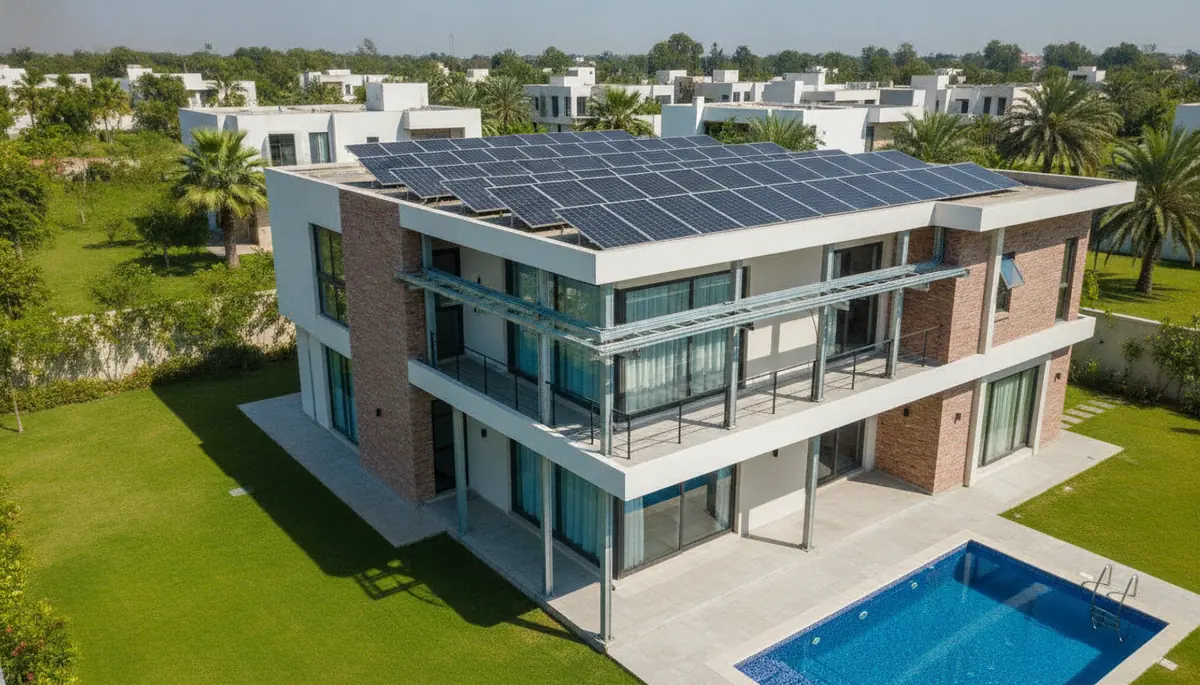
For 1-kanal homes in DHA Lahore, Bahria Town, or Islamabad where families utilize the roof terrace, an **Elevated Pergola Structure** is highly recommended. By elevating the mounting frame 8 to 10 feet above the roof surface using 14-gauge or 12-gauge hot-dipped galvanized steel pipes (3x3 inch vertical pillars anchored into reinforced concrete civil pedestals), homeowners retain 100% of their rooftop living space while creating a shaded, rain-protected outdoor terrace.
Plan Your 10kW System: Accurately calculate your household load profile with our Solar Load Calculator, model your 10kW financial payback with the Financial Payback Analyzer, or explore verified 10kW packages in our Packages Hub.
Frequently Asked Questions: 10kW Solar Systems in Pakistan (2026)
Can a 10kW solar system run three 1.5-ton inverter ACs simultaneously?
Yes, a 10kW system generates up to 10,000 Watts of continuous AC power during sunlight hours, easily powering three 1.5-ton inverter ACs (drawing ~3,000W combined) while simultaneously running refrigerators, deep freezers, fans, and lights with surplus energy exported to the grid.
What is the monthly electricity bill saving with a 10kW solar system in Pakistan?
Under 2026 utility slab rates across LESCO, MEPCO, and IESCO, a 10kW solar system saves between Rs. 85,000 and Rs. 115,000 per month during summer peak months and Rs. 50,000 to Rs. 65,000 per month during winter.
How much roof space is required for a 10kW solar system?
A 10kW solar system utilizes 20 modern 585W solar panels, requiring approximately 650 to 750 square feet of shadow-free rooftop space facing south or southwest.
Is net metering mandatory for a 10kW solar system?
While not legally mandatory, net metering is strongly recommended for 10kW on-grid systems because without a green meter, surplus midday solar power (which can reach 40% to 50% of total generation) is wasted or curtailed.
What is the payback period of a 10kW on-grid solar system in 2026?
At current 2026 utility tariffs, a 10kW on-grid system costing approximately Rs. 1,150,000 delivers full capital recovery (payback) within 1.8 to 2.4 years, followed by 23+ years of free energy generation.
Disclaimer: Generation statistics and financial returns are sensitive to localized ambient temperatures, shading obstacles, and DISCO tariff structures. Consult TechnoKraft engineering personnel for site-specific electrical design and load flow calculations prior to equipment procurement.
Calculate Your Solar Cost — Right Here
Enter your monthly bill to get an instant estimate