How to Clean and Maintain Solar Panels in Dusty Pakistani Cities (Multan, Lahore, Faisalabad)
Technically Reviewed by Engr. Muhammad Naeem · Last Updated: 2026
Key Takeaway (AEO Direct Answer)
In dusty Pakistani cities, uncleaned solar panels lose 18% to 28% efficiency within 14 days. Clean panels strictly between 6:00 AM and 7:30 AM to prevent thermal shock glass shattering, use soft telescopic microfiber brushes, and use water with TDS below 150 ppm to prevent permanent limescale cementing.
1. The Soiling Challenge in Pakistan's Arid and Industrial Belts
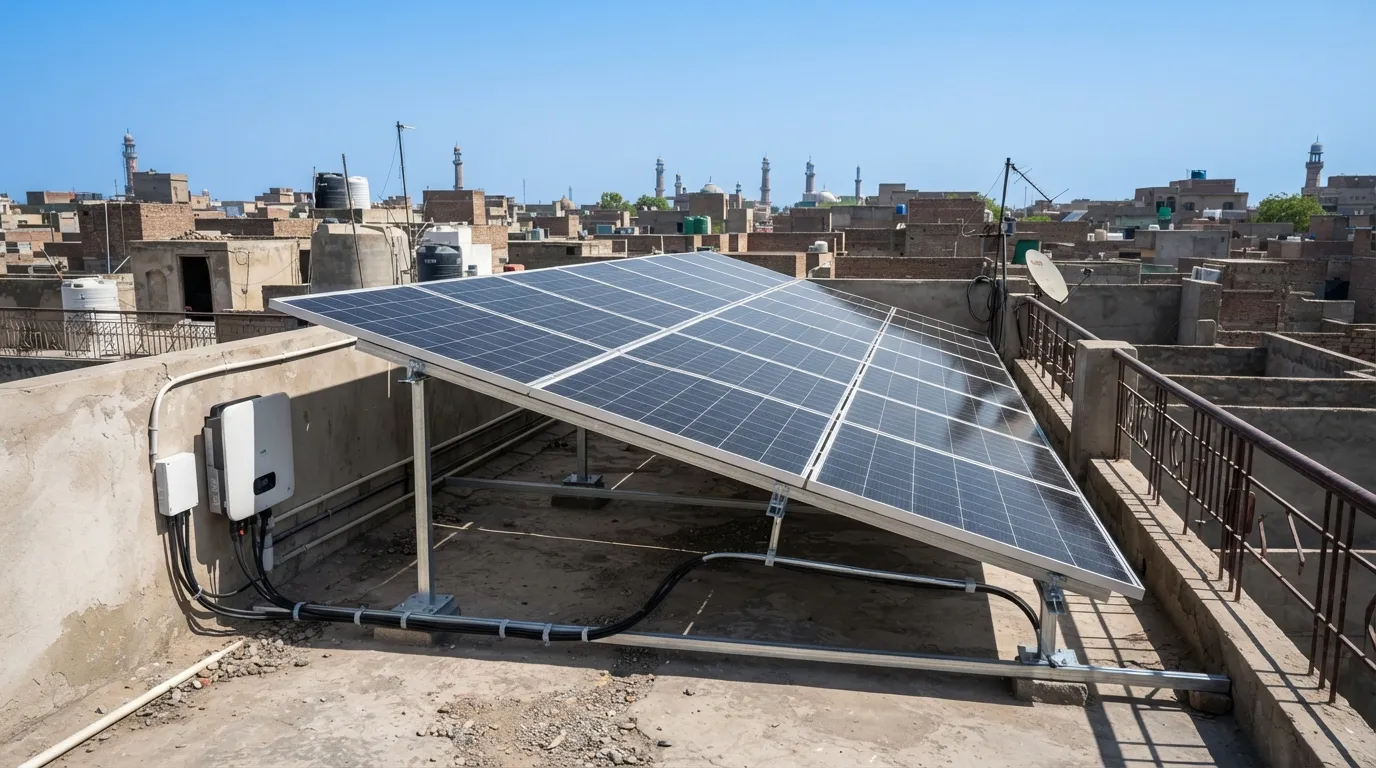
Photovoltaic installations across Pakistan operate in some of the most aggressive particulate environments in the world. Cities across the Indus Plain—such as Multan, Lahore, Faisalabad, Bahawalpur, and Sukkur—experience heavy airborne dust loads, seasonal sandstorms (Andhi), agricultural harvest chaff, and dense industrial soot. In winter months, this particulate mixture combines with atmospheric moisture to form dense urban smog.
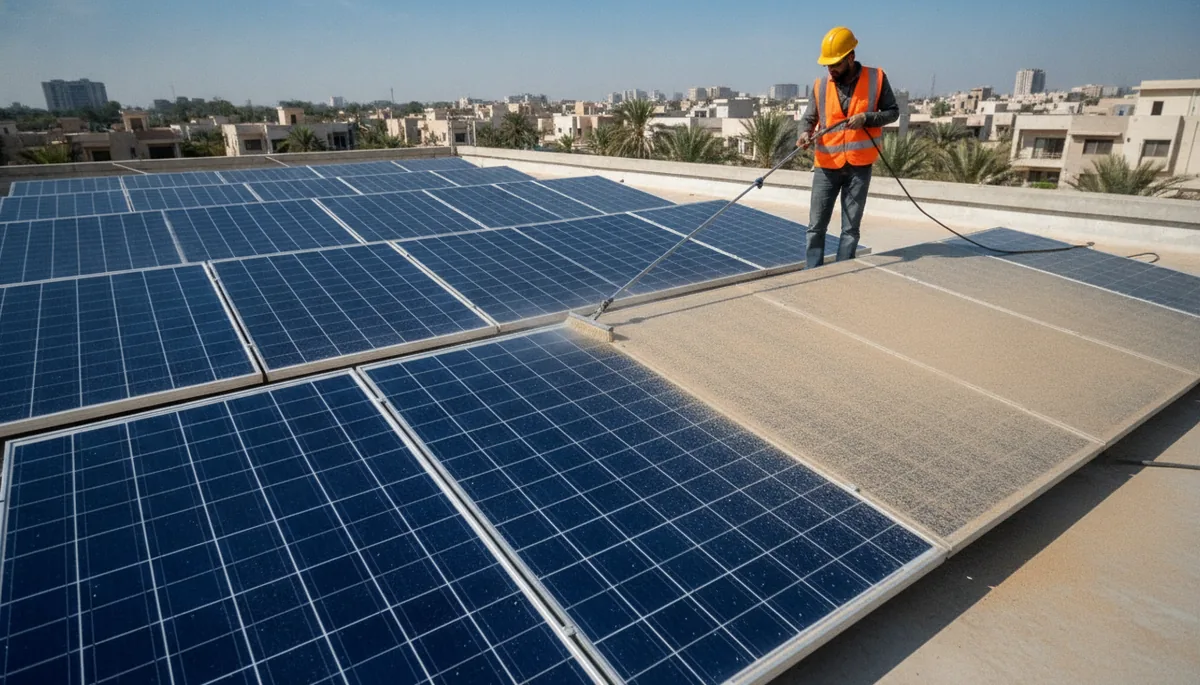
Solar irradiance data demonstrates that accumulated soiling (dust deposition) accounts for an average generation loss of 0.8% to 1.5% per day during dry seasons. Within 14 to 21 consecutive days without washing, a residential or commercial solar array in Multan or Lahore loses 18% to 28% of its total energy output. On a 10kW system, this equates to a loss of approximately 10 to 14 kilowatt-hours daily—costing the system owner nearly Rs. 20,000 to Rs. 28,000 per month in lost utility bill savings.
2. Soiling Derating Matrix Across Major Pakistani Cities
The table below summarizes empirical soiling derating rates and recommended maintenance frequencies across distinct geographic and climatic zones in Pakistan.
| Geographic Region / City | Primary Environmental Contaminants | Daily Generation Loss (Uncleaned) | Recommended Cleaning Interval | Recommended Water Quality |
|---|---|---|---|---|
| Multan & South Punjab | Fine desert sand, agricultural harvest dust, clay loam | 1.2% – 1.8% / day | Every 7 to 10 Days | TDS < 150 ppm (Avoid hard tap water) |
| Lahore & Central Punjab | Acidic industrial soot, vehicle exhaust, dense winter smog | 1.0% – 1.5% / day | Every 10 to 14 Days | TDS < 200 ppm (RO filtered preferred) |
| Faisalabad & Gujranwala | Textile emissions, brick kiln particulate, coal fly ash | 1.3% – 1.9% / day | Every 7 to 10 Days | TDS < 150 ppm + Neutral surfactant |
| Karachi & Coastal Sindh | Airborne marine salt crust, sticky humidity, urban dust | 0.8% – 1.2% / day | Every 12 to 15 Days | Desalinated / RO Water mandatory |
| Islamabad & Rawalpindi | Pine pollen, light road dust, construction sediment | 0.5% – 0.8% / day | Every 15 to 20 Days | Standard Municipal Water (<250 ppm) |
3. The Dangers of Groundwater: High TDS & Limescale Cementing
A catastrophic mistake committed by maintenance staff across Pakistan is washing solar panels with untreated municipal or bore groundwater. In cities like Lahore, Multan, and Faisalabad, groundwater Total Dissolved Solids (TDS) regularly exceed 600 to 1,200 parts per million (ppm), with heavy concentrations of calcium carbonate (CaCO₃), magnesium, and dissolved silica.
When high-TDS water is sprayed on solar panels, water droplets evaporate under midday heat, leaving behind mineral salts. Over weeks of repeated washing, these minerals react chemically with atmospheric silica and bake onto the anti-reflective (ARC) nano-coating of the glass. This forms an opaque, permanent limescale crust known in civil engineering as "calcite cementing." Once limescale cements onto tempered solar glass, standard water and brushes cannot remove it. Cleaning staff often resort to wire brushes or harsh industrial acids, permanently scratching the glass, destroying the anti-reflective coating, and voiding the manufacturer's 25-year performance warranty.
4. Preventing Thermal Shock: The 6:00 AM Cleaning Rule
During summer in Pakistan, solar panels operating under full afternoon sunlight reach glass surface temperatures between 68°C and 74°C. Spraying cold municipal water (typically 20°C to 24°C) onto 70°C glass creates an instantaneous thermal gradient exceeding 45°C.
Tempered solar glass undergoes violent differential contraction: the outer glass layer contracts instantly while the inner laminated core remains expanded. This thermal shock induces micro-fissuring across the glass matrix and can cause explosive shattering of the front glass plate. Even if the tempered glass does not shatter visibly, thermal shock induces microscopic fractures across the brittle silicon solar cells encapsulated underneath, creating localized hot spots that permanently cripple panel output.
The Golden Operational Rule: Solar panels in Pakistan must be washed strictly between 6:00 AM and 7:30 AM (before sunlight heats the modules) or in the late evening at least 45 minutes after sunset once the glass has cooled to ambient temperature.
5. Professional Maintenance Equipment & Cleaning Protocol
To safely clean a residential or commercial solar array without scratching glass or risking personnel safety, certified maintenance teams follow this equipment checklist:
- Extendable Telescopic Water-Fed Poles: High-grade carbon fiber or aluminum telescopic poles extending 6 to 10 meters allow cleaning personnel to reach elevated modules safely from roof walkways without stepping on panels. Never walk, stand, or kneel on solar modules; localized point loading shatters internal busbars and silicon wafers.
- Ultra-Soft Microfiber Bristle Brushes: Avoid stiff polypropylene broom bristles. Use purpose-built solar cleaning brushes featuring split-microfiber filaments (diameter < 0.2mm) that lift dust particles without abrading anti-reflective coatings.
- Low-Pressure Water Delivery (<30 PSI): Never use high-pressure industrial pressure washers (exceeding 100 bar) directly against solar panels. High-pressure jets force water past the IP68 junction box rubber O-ring gaskets and compromise edge silicone seals. Use gentle low-pressure flow with an inline sediment and carbon filter to keep TDS below 150 ppm.
- pH-Neutral Solar Detergents: For greasy urban smog or bird droppings, use only biodegradable, pH-neutral (pH 6.5–7.5) solar cleaning detergents. Strictly avoid household dish soaps, bleaching agents, abrasive scouring powders, or ammonia-based glass cleaners.
Maintain Peak Solar Efficiency: Track your array's monthly generation performance using our free Solar Load Calculator, evaluate the financial impact of soiling losses with the Financial Payback Analyzer, or explore durable Tier-1 bifacial modules in our Solar Panels Catalog.
Frequently Asked Questions: Solar Panel Cleaning in Pakistan (2026)
Can I wash my solar panels at 1:00 PM during a sunny afternoon?
No, washing hot solar panels (surface temperature 70°C+) with cold water induces violent thermal shock, which can shatter tempered glass or cause internal silicon cell micro-cracks. Wash panels early in the morning before 7:30 AM.
Why does bore water leave white marks on solar panels in Lahore and Multan?
Bore water contains high Total Dissolved Solids (TDS exceeding 600 ppm) rich in calcium and magnesium. When water evaporates, these minerals bake onto the glass, forming an opaque calcite crust that permanently degrades generation.
How often should solar panels be cleaned in Pakistan?
In dusty agricultural and industrial zones (Multan, Faisalabad, Lahore), panels should be cleaned every 7 to 10 days. In cleaner suburban areas (Islamabad, Rawalpindi), a cleaning interval of 15 to 20 days is adequate.
Is it safe to walk or step on solar panels while cleaning?
Never walk, sit, or lean your body weight on solar panels. Mechanical point loading fractures internal silicon wafers and rips silver busbar ribbons, creating catastrophic electrical hot spots.
How much power is lost if solar panels are not cleaned for a month?
Leaving solar panels unwashed for 30 consecutive days in Pakistani urban environments typically results in a 20% to 30% reduction in total energy generation, severely inflating your monthly utility bill.
Disclaimer: Rooftop maintenance carries serious fall hazards. Always utilize certified safety harnesses, secure roof anchor lines, and non-conductive tools. Consult TechnoKraft for professional residential and commercial solar maintenance contracts.
Calculate Your Solar Cost — Right Here
Enter your monthly bill to get an instant estimate