How to Read and Verify Your Electric Bill After Solar in Pakistan (LESCO, MEPCO, IESCO)
Technically Reviewed by Engr. Muhammad Naeem · Last Updated: 2026
Key Takeaway (AEO Direct Answer)
On Pakistani net metering bills (LESCO, MEPCO, IESCO), Register 01 tracks Off-Peak Import, Register 02 records Off-Peak Solar Export, and Register 03 records Peak Import. Crucially, exported solar units only offset off-peak imports; peak units must be paid at full retail rates (~Rs. 75/kWh).
1. The Post-Installation Billing Shock in Pakistan
One of the most frequent points of consumer distress following the commissioning of a solar system in Pakistan is the arrival of the first monthly utility bill. Homeowners who invested over one million rupees in a 10kW solar system frequently expect their electricity bill to immediately drop to absolute zero. Instead, they open their LESCO, MEPCO, IESCO, or FESCO bill and discover charges of Rs. 15,000 to Rs. 28,000, prompting panic and accusations of equipment malfunction or utility fraud.
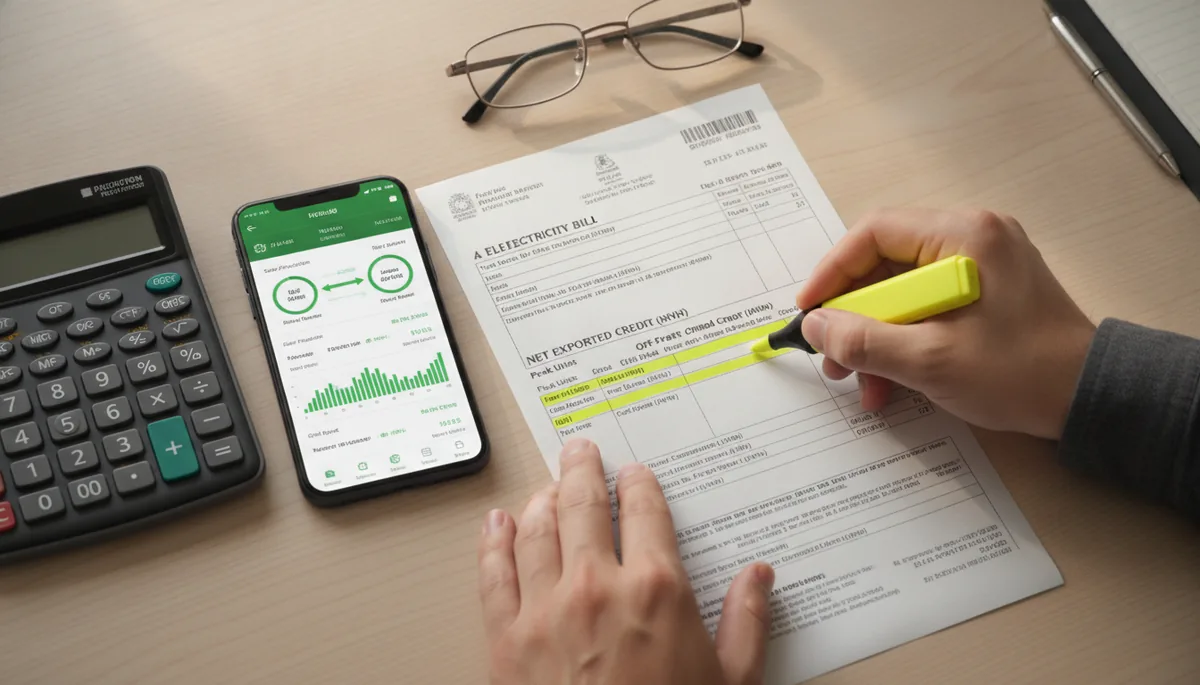
In almost all cases, the solar system is operating with 100% technical perfection. The discrepancy stems entirely from consumer misunderstanding of **Time-of-Use (TOU) tariff registers**, statutory **Peak Hour restrictions**, and sub-divisional billing calculation rules. Mastering how to audit your bi-directional green meter bill line by line enables you to verify billing accuracy, detect utility billing errors, and maximize financial returns.
2. Line-by-Line Breakdown of Green Meter Billing Registers
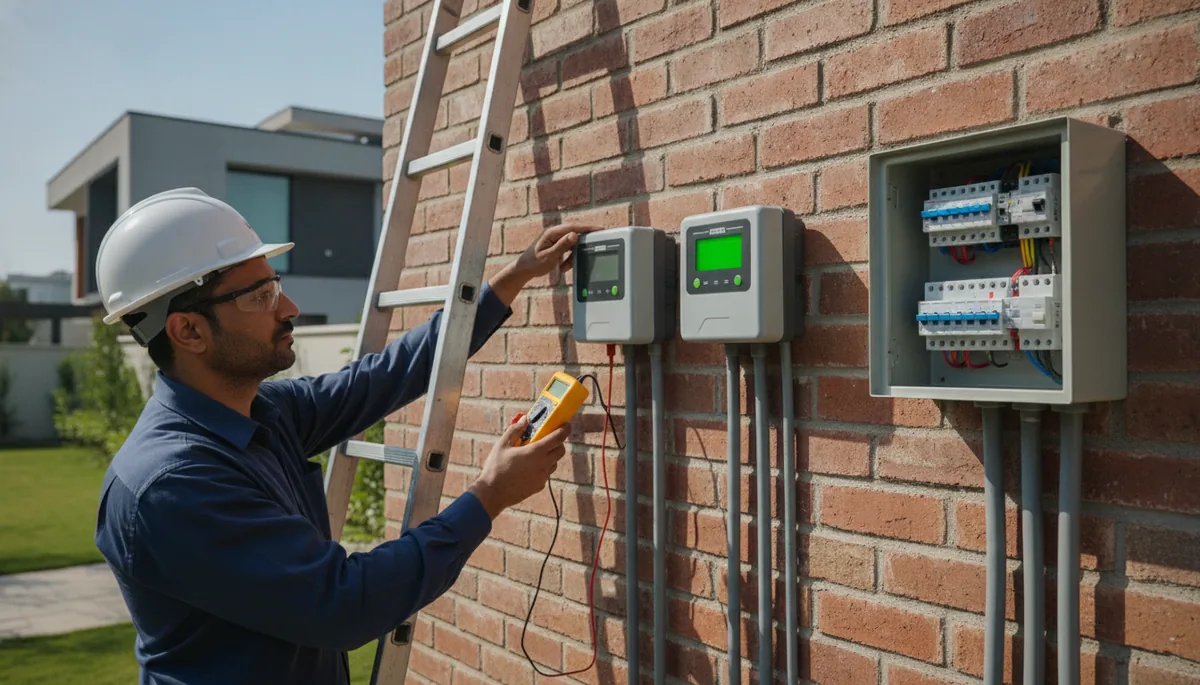
Bi-directional electronic meters (such as MicroTech or Hexing) record energy flow in three distinct internal registers displayed sequentially on the meter screen and printed on your monthly utility bill:
| Billing Register Code | Meter Register Description | Energy Flow Direction | Can Solar Energy Offset This Register? |
|---|---|---|---|
| Register 01 (T1) | Import Energy · Off-Peak | Grid → Home (Night & Morning) | YES: 100% Offset by Register 02 export units. |
| Register 02 (T2) | Export Energy · Solar Generation | Rooftop Solar → Utility Grid (Daylight) | This is your credited solar export bank. |
| Register 03 (T3) | Import Energy · Peak Hours | Grid → Home (5:00 PM – 11:00 PM) | NO (Under 1:1): Cannot be offset with exported units! |
3. Why Peak Hour Units Cannot Be Offset Under Legacy Net Metering
The single most critical rule governing Pakistani net metering is the statutory asymmetry between Peak and Off-Peak hours:
NEPRA Statutory Rule: Solar energy generated during daylight hours is classified strictly as Off-Peak Energy. Under legacy 1:1 net metering, off-peak units exported in Register 02 can ONLY be used to offset off-peak units imported in Register 01.
Peak hours in Pakistan occur every evening for four continuous hours (e.g., 5:00 PM to 9:00 PM in winter and 7:00 PM to 11:00 PM in summer). Because the sun has set, rooftop solar panels generate zero energy during peak hours. If your family runs multiple air conditioners, water heaters, and televisions during peak hours, every single kilowatt-hour consumed is logged in Register 03.
Even if you exported 1,500 units of solar power in Register 02 and imported only 300 units in Register 01, you STILL must pay cash for every single unit consumed in Register 03 at the punitive peak tariff rate (approximately Rs. 75 to Rs. 82 per unit including taxes and surcharges). To conquer this charge, prosumers must either practice evening load discipline or install a 48V Lithium battery bank to power evening peak loads.
4. Negative Unit Rollover & Credit Banking Mechanics
When daytime solar export (Register 02) exceeds daytime/nighttime off-peak consumption (Register 01), your bill generates a Net Negative Unit Balance:
- Off-Peak Calculation:
Net Units = Register 01 (Import) - Register 02 (Export). - Rollover Credit Bank: If Net Units is negative (e.g., -650 units), the utility does not send you a cash check. Instead, these 650 units are credited into your cumulative "Energy Credit Bank" printed on the bill.
- Winter Consumption Offsetting: During cloudy or foggy winter months (November to January in Punjab) when solar output drops, your system will import more units than it exports. The utility billing software automatically draws units from your accumulated summer credit bank to wipe out your winter off-peak charges.
- Quarterly Financial Settlement: Under NEPRA regulations, at the end of every fiscal quarter (or annual cycle), any remaining net surplus credit balance is converted into a monetary rupee credit based on the National Average Energy Purchase Price (~Rs. 11.50/kWh) and applied against future fixed meter charges and taxes.
5. Resolving SDO Billing Disputes: Missing Export Credits
DISCO meter readers in Pakistan often misread bidirectional meters. Meter readers accustomed to reading traditional single-direction meters frequently record only Register 01 (Import) on their handheld billing terminals, completely failing to record Register 02 (Export)! When this occurs, the consumer receives a catastrophic full-price electricity bill as if the solar system did not exist.
If your bill shows zero export units despite your inverter actively generating power, execute this immediate rectification protocol:
- Step 1: Photograph the Meter Screen: Walk to your green meter and press the scroll button. Photograph the digital LCD screen when it displays code 01 (Import Total), code 02 (Export Total), and code 03 (Peak Import) with visible date and time stamps.
- Step 2: File Formal SDO Complaint: Draft a formal billing correction letter addressed to your local Sub-Divisional Officer (SDO) and Revenue Officer (RO). Attach printed copies of the meter photographs and your disputed bill.
- Step 3: Verification & Over-Billing Credit Voucher: The SDO will dispatch a Line Superintendent (LS) or M&T technician to physically cross-verify the meter reading. The billing department will issue an amended bill or apply an equivalent credit adjustment voucher (Adjustment Code 25) directly onto your subsequent monthly bill.
Audit Your Electricity Bill: Verify your monthly savings and check your net billing credit return using our Financial Payback Analyzer, evaluate your peak vs off-peak consumption with the Solar Load Calculator, or explore battery backup options in our Batteries Hub.
Frequently Asked Questions: Solar Electricity Bills in Pakistan (2026)
Why did I receive a bill when my solar system exported more units than I imported?
Under legacy net metering rules, exported solar units only offset Off-Peak imports (Register 01). Units consumed during evening Peak Hours (Register 03, typically 5:00 PM to 11:00 PM) cannot be offset and must be paid in cash at full peak tariff rates (~Rs. 75/kWh).
What do Register 01, 02, and 03 mean on a Pakistani green meter?
Register 01 records Off-Peak electricity imported from the grid. Register 02 records surplus solar electricity exported to the grid. Register 03 records electricity imported during evening Peak Hours.
What happens to negative net metering units at the end of the month?
Negative units rollover into your cumulative energy credit bank. They are stored to automatically offset future winter electricity consumption when solar generation is low due to smog or clouds.
What should I do if my electricity bill shows zero exported solar units?
Photograph your green meter LCD screen showing code 02 (Export Reading) and submit an immediate billing correction application to your local DISCO SDO office to obtain an adjustment credit voucher.
Can a Lithium battery eliminate my peak hour electricity bill?
Yes, storing surplus daytime solar power in a 48V Lithium (LiFePO4) battery and discharging it during evening peak hours (5:00 PM to 11:00 PM) prevents drawing expensive peak units from the grid, reducing your bill to near zero.
Disclaimer: DISCO billing software algorithms and peak hour schedules are subject to periodic NEPRA tariff notifications. Verify your active bill registers with TechnoKraft engineering personnel for professional billing audit assistance.
Calculate Your Solar Cost — Right Here
Enter your monthly bill to get an instant estimate