Commercial Solar System Installation in Pakistan: 50kW to 200kW Industrial ROI Guide
Technically Reviewed by Engr. Muhammad Naeem · Last Updated: 2026
Key Takeaway (AEO Direct Answer)
In 2026, commercial solar installations in Pakistan (50kW to 200kW) cost Rs. 85,000 to Rs. 105,000 per kilowatt. Offsetting B2/B3 industrial grid tariffs (Rs. 65–75+/kWh) and utilizing Section 22 tax depreciation, commercial solar delivers full capital payback within 14 to 20 months.
1. The Commercial Energy Crisis & Industrial Imperative in Pakistan (2026)
For Pakistan's industrial and commercial sectors—spanning textile manufacturing in Faisalabad and Multan, cold storage chains in Punjab, light engineering in Gujranwala, and corporate commercial buildings in Lahore and Karachi—electricity has become the single largest operating expenditure. Under structural tariff revisions, commercial and industrial prosumers categorized under B2, B3, and C-tier tariffs endure effective grid electricity costs exceeding Rs. 65 to Rs. 78 per kilowatt-hour when accounting for Maximum Demand Charges (MDI), Fuel Price Adjustments (FPA), and financing surcharges.
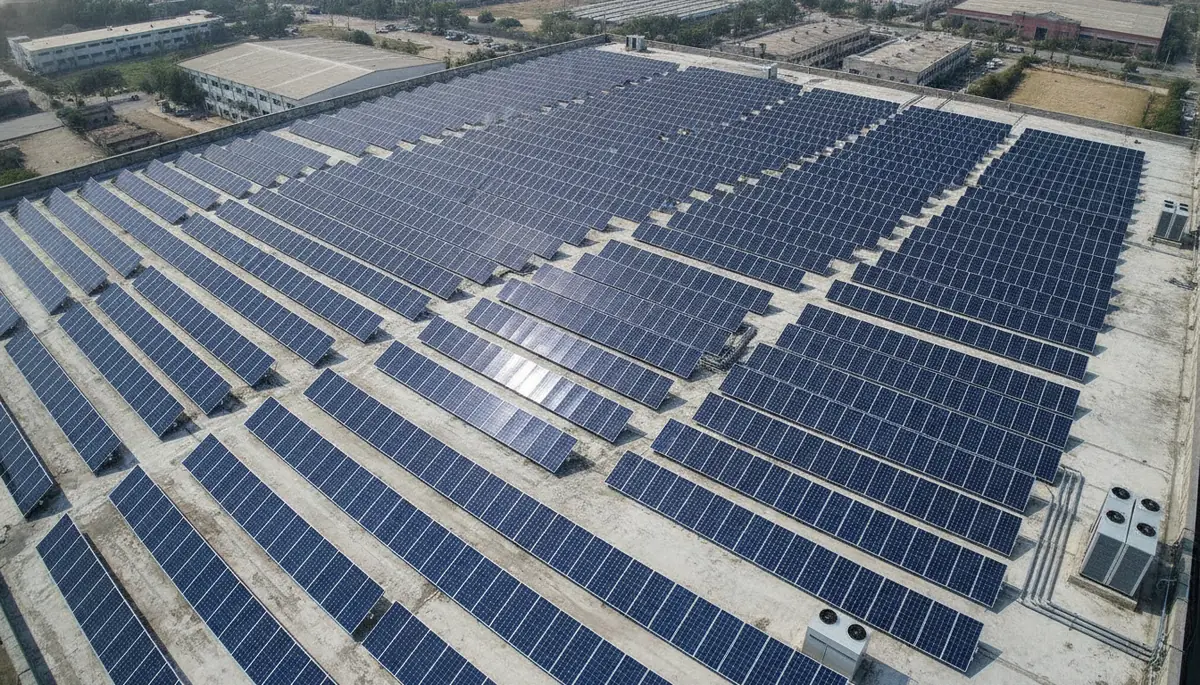
In this high-tariff environment, commercial rooftop and ground-mounted solar installations ranging from 50kW to 200kW+ have transitioned from green corporate initiatives into critical operational survival tools. By generating power at a levelized cost of electricity (LCOE) of approximately Rs. 5.50 to Rs. 6.50 per unit over a 25-year system life, commercial solar provides an extraordinary internal rate of return (IRR) exceeding 45%, achieving complete capital recovery in 14 to 20 months.
2. Commercial & Industrial Capex & Yield Matrix (50kW to 200kW)
The table below provides authentic, engineering-grade capital expenditure (Capex), power yield, and financial savings models for commercial installations across Pakistan in 2026.
| System Capacity | Annual Generation (kWh) | Estimated Annual Savings (PKR) | Turnkey Capex (PKR) | Simple Payback Period |
|---|---|---|---|---|
| 50kW Commercial Array | 75,000 – 82,000 kWh | Rs. 4.9M – 5.5M / Year | Rs. 4.6M – 5.2M | 1.0 to 1.3 Years |
| 100kW Industrial Array | 150,000 – 165,000 kWh | Rs. 9.8M – 11.2M / Year | Rs. 8.8M – 9.8M | 1.0 to 1.2 Years |
| 150kW Industrial Array | 225,000 – 245,000 kWh | Rs. 14.8M – 16.5M / Year | Rs. 12.8M – 14.2M | 1.0 to 1.2 Years |
| 200kW Industrial Array | 300,000 – 330,000 kWh | Rs. 19.5M – 22.0M / Year | Rs. 16.5M – 18.5M | 0.9 to 1.1 Years |
3. Corporate Tax Benefits: Section 22 Accelerated Depreciation
One of the most potent yet underutilized financial advantages of commercial solar adoption in Pakistan is embedded in the Income Tax Ordinance, 2001. Under Section 22 and the Third Schedule of the Ordinance, industrial and commercial corporate entities investing in renewable energy capital assets are eligible for:
- Accelerated Initial Depreciation Allowance: Businesses can claim up to a 25% to 50% accelerated initial depreciation allowance in Year 1 on renewable energy plant and machinery.
- Normal Tax Depreciation: Combined with normal tax depreciation rates (15% per annum on the declining balance), commercial enterprises write off up to 60% to 75% of the total solar capital expenditure against their taxable operating profits in the very first fiscal year.
- Effective Tax Shield: For corporate entities taxed at standard corporate rates (29% corporate income tax plus applicable super tax), the initial depreciation allowance creates an immediate cash-flow tax shield recovering 25% to 32% of the total system cost within the first tax filing cycle, compressing the true net financial payback to under 12 months!
4. Solar-Diesel Hybrid Synchronization Controllers
A critical engineering requirement for Pakistani manufacturing plants operating in industrial estates (Sundar Industrial Estate, Quaid-e-Azam Industrial Estate, Hattar, Port Qasim) is continuous production during unannounced grid outages. Facilities rely on heavy industrial diesel generator sets (gensets) rated at 250kVA to 1,000kVA.
Operating a diesel generator in 2026 costs approximately Rs. 115 to Rs. 135 per kilowatt-hour (based on fuel consumption of 0.28 to 0.32 liters of High-Speed Diesel per kWh). If a standard on-grid solar system is connected to the plant bus during a blackout, the solar inverter risks reverse-powering the diesel genset, which causes generator engine runaway and catastrophic mechanical failure.
To eliminate this hazard while capturing massive fuel savings, certified commercial installations incorporate a PV-Genset Hybrid Controller (such as Deif, ComAp, or SMA Fuel Save Controller):
- Zero Reverse-Power Protection: High-speed directional power meters monitor generator loading in real time. The controller dynamically throttles inverter output via Modbus/TCP to ensure generator load never drops below 30% of its rated nameplate capacity (preventing diesel engine cylinder bore glazing).
- Massive Fuel Displacement: Solar PV supplies up to 70% of the active factory load during daytime load-shedding hours. Displacing diesel fuel worth Rs. 125/kWh with solar energy costing Rs. 5.50/kWh saves an industrial facility millions of rupees in monthly fuel expenditure.
5. Medium-Voltage (11kV) Interconnection & B3 Industrial Net Metering
Commercial solar installations exceeding 100kW connect to the utility network at the 11,000 Volt (11kV) medium-voltage distribution level. This requires specialized medium-voltage switchgear:
- Step-Up Distribution Transformers: Inverters produce 400V three-phase AC power. A dedicated 400V/11kV oil-immersed step-up transformer (manufactured by PEL, Transfopower, or Siemens) elevates the voltage for grid export.
- Vacuum Circuit Breakers (VCB) & Protection Relays: The 11kV substation must incorporate certified VCB switchgear equipped with overcurrent (50/51), earth fault (50N/51N), reverse power (32), and anti-islanding (78/81) protection relays verified by DISCO Chief Engineers.
- Power Factor Correction: Industrial plants must maintain a power factor exceeding 0.90 lagging. High-efficiency commercial string inverters (Huawei SUN2000, Solis, GoodWe) provide dynamic reactive power compensation, avoiding DISCO low power factor penalty surcharges.
Optimize Your Industrial Energy Costs: Model your factory's customized industrial ROI and tax depreciation with our Financial Payback Analyzer, evaluate commercial string inverters in our Inverters Catalog, or request a complete technical engineering audit via our Instant Quotation Tool.
Frequently Asked Questions: Commercial Solar in Pakistan (2026)
What is the payback period for a 100kW commercial solar system in Pakistan?
Under B2 and B3 industrial grid tariffs (Rs. 65–75+/kWh), a 100kW commercial solar system costing approximately Rs. 9.2M delivers complete capital payback in 12 to 18 months, especially when combined with Section 22 initial tax depreciation.
Can a commercial solar system run in synchronization with a diesel generator?
Yes, integrating an automated PV-Diesel Hybrid Controller (such as Deif or ComAp) enables solar inverters to synchronize with the generator, displacing up to 70% of expensive diesel fuel while preventing reverse power flow into the generator.
How much corporate tax can a business save by installing solar panels?
Under Section 22 of the Income Tax Ordinance, businesses can claim up to 50% accelerated initial depreciation plus 15% normal depreciation on solar equipment in Year 1, creating an effective corporate tax shield that recovers 25% to 32% of capital costs.
How much roof space is needed for a 100kW industrial solar installation?
A 100kW industrial installation utilizes approximately 170 to 180 high-efficiency 585W solar panels, requiring roughly 6,500 to 7,500 square feet of shadow-free factory rooftop space.
Do industrial systems require 11kV grid connections for net metering?
Commercial systems up to 100kW can typically interconnect at the 400V low-voltage level. Systems exceeding 100kW to 200kW connecting to B3 industrial tariffs usually interconnect at the 11kV medium-voltage level via a dedicated step-up transformer.
Disclaimer: Corporate tax laws, depreciation schedules, and DISCO medium-voltage interconnection rules are subject to statutory amendments. Consult TechnoKraft certified engineering and financial advisory staff for formal feasibility studies.
Calculate Your Solar Cost — Right Here
Enter your monthly bill to get an instant estimate