How to Identify Original vs Fake Tier-1 Solar Panels in Pakistan (Barcode & Flash Test)
Technically Reviewed by Engr. Muhammad Naeem · Last Updated: 2026
Key Takeaway (AEO Direct Answer)
To identify authentic Tier-1 solar panels in Pakistan, verify the permanent barcode encapsulated under the front tempered glass, scan the encrypted serial using the manufacturer's official verification app, inspect busbars for clean 16BB laser micro-soldering, and demand the importer's official batch flash test report.
1. The Counterfeit Epidemic in Pakistan's Solar Wholesale Markets
As rooftop solar installations surge across Pakistan, the market has been flooded with counterfeit, factory-reject, and re-labeled photovoltaic panels. Unscrupulous open-market traders in major commercial distribution centers—such as Hall Road and Shah Alam Market in Lahore, Regal Chowk in Karachi, and College Road in Rawalpindi—routinely capitalize on consumer confusion. They acquire Grade-B, Grade-C, or salvaged decommissioned modules, polish outer frames, apply counterfeit stickers of Tier-1 brands (Longi, Jinko, Canadian Solar, JA Solar), and market them at standard Grade-A rates.
Installing counterfeit solar panels inflicts devastating long-term consequences: initial generation deficits of 20% to 35%, rapid EVA backsheet yellowing within 18 months, catastrophic micro-cracking, potential thermal fire hazards, and zero manufacturer warranty recourse. Learning how to scientifically verify authentic Grade-A hardware using non-destructive inspection techniques is vital for protecting your capital investment.
2. The 5-Point Authentication Protocol for Tier-1 Solar Panels
Certified solar engineers apply a comprehensive five-stage physical and digital verification protocol before accepting any container or pallet shipment of solar modules in Pakistan:
| Verification Point | Counterfeit / Grade-B Defect Indicator | Authentic Tier-1 Grade-A Standard |
|---|---|---|
| 1. Barcode Encapsulation | Surface sticker applied on top of outer glass; easy to scratch off. | Permanently laminated underneath the tempered glass during lamination. |
| 2. Cell Busbar Micro-Welding | Crooked, hand-soldered ribbons; visible flux stains; uneven spacing. | Precision laser-welded 16BB or 18BB micro-wires; zero solder splatter. |
| 3. EVA & Backsheet Laminate | Air bubbles (delamination); milky residue; wrinkles on rear backsheet. | Uniform crystal-clear vacuum seal; flawless dual-glass or backsheet finish. |
| 4. Junction Box & Potting | Hollow junction box; loose bypass diodes; unsealed cable glands. | IP68 certified box completely filled with solid silicone heat-dissipating potting gel. |
| 5. Factory Flash Test Match | No factory test report; barcode does not register on official cloud portal. | Serial number matches manufacturer ERP database returning exact Pmax, Voc, Isc. |
3. Testing the Under-Glass Encapsulated Barcode
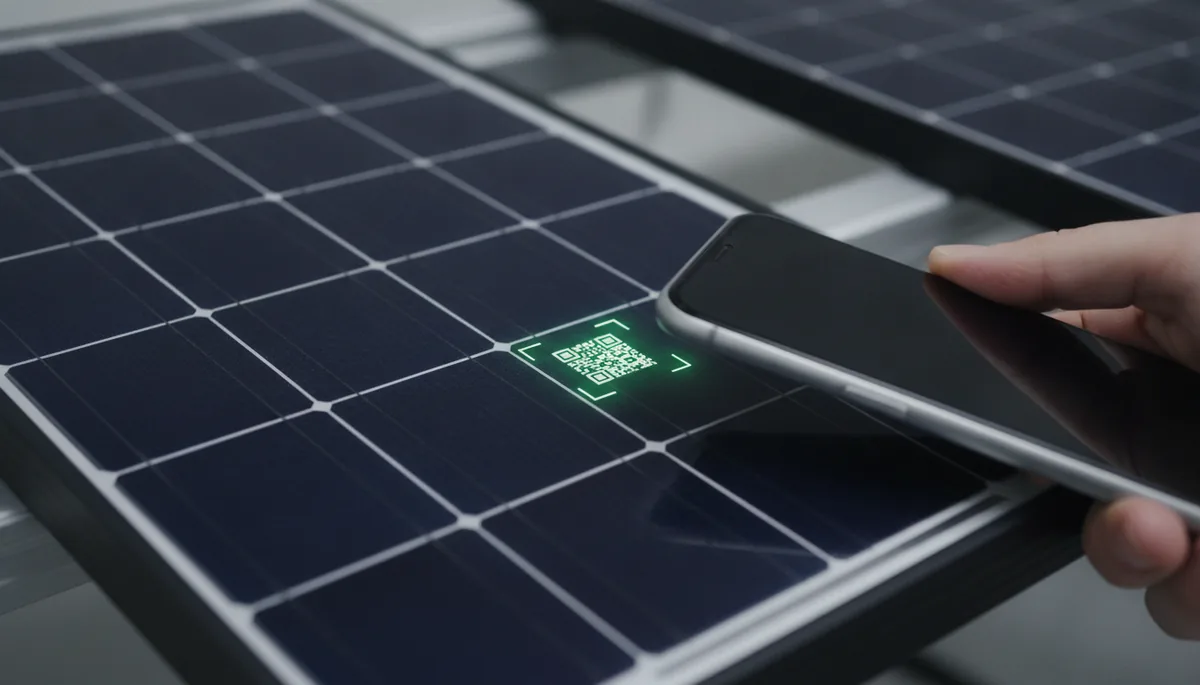
The foremost physical barrier separating authentic Tier-1 panels from counterfeit re-stickered units is barcode placement. Genuine manufacturers (including Jinko Solar, Longi Green Energy, and Canadian Solar) place a high-resolution printed QR code and alphanumeric serial number directly beneath the front 3.2mm anti-reflective coated tempered glass prior to entering the automated vacuum laminator.
To verify: run your fingernail firmly across the barcode located in the upper corner of the panel face. If your nail catches against a label edge, or if the barcode can be peeled, scratched, or softened using isopropyl alcohol, you are holding a counterfeit panel. On an authentic panel, your finger slides across uninterrupted, perfectly smooth tempered glass.
4. Official Manufacturer Mobile App Verification Protocols
Leading Tier-1 manufacturers provide encrypted cloud database verification accessible via mobile smartphones. When inspecting a pallet delivery in Pakistan, execute these digital checks:
- Longi Solar App: Download the official Longi Solar Verification mobile app. Position your camera over the QR code located beneath the glass. The app decrypts the serial number and connects to Longi's manufacturing ERP server. Authentic modules return the exact production date, manufacturing facility (e.g., Xi'an, Jiaxing), module model (e.g., LR5-72HBD-585M), and the individual panel's factory flash test output.
- Jinko Solar Tracking Portal: Jinko embeds encrypted QR codes on its Tiger Neo N-Type series. Scanning the code via the official Jinko portal verifies whether the module was allocated to an authorized Pakistani distributor (such as Inverex, Diwan, or Netracon) or diverted from unverified secondary channels.
- Cross-Referencing Exterior Frame Stickers: The serial number printed on the under-glass barcode must match the barcode sticker attached to the outer aluminum frame and the master barcode on the external cardboard shipping pallet. If any digit differs, the pallet has been tampered with.
5. Verifying the Distributor Batch Flash Test Report
Every legitimate shipping container of Tier-1 solar modules arrives with an official manufacturer Sun Simulator Flash Test Report. During factory quality control, each module is exposed to standard test condition (STC) illumination (1,000 W/m² at 25°C cell temperature) to measure its true electrical characteristics.
Demand an electronic copy of this flash report from your turn-key installer or equipment dealer. Verify that your panel's individual serial number appears on the document alongside these four critical parameters:
- Pmax (Maximum Power): Must equal or exceed the nameplate rating (e.g., a 585W panel must read 585.0W to 588.5W, verifying positive power tolerance of 0 to +3%).
- Voc (Open Circuit Voltage): Must measure within ±1.5% of the published datasheet value (typically ~51.5V for 72-cell N-Type modules).
- Isc (Short Circuit Current): Must measure within ±2.0% of the datasheet (typically ~14.2A to 14.6A).
- Fill Factor (FF): The ratio of maximum power to the product of Voc and Isc (
FF = Pmax / [Voc × Isc]). On authentic Grade-A N-Type TOPCon panels, the Fill Factor must exceed 78.5% to 80.0%. A Fill Factor below 75% indicates high internal series resistance, cell shunts, or defective wafer crystalline structure.
Source Verified Hardware: Never gamble with open-market solar panels. Explore verified Tier-1 models in our Solar Panels Catalog, calculate your exact required panel quantity using our Solar Load Calculator, or request a verified turn-key quote via our Instant Quotation Tool.
Frequently Asked Questions: Original vs Fake Solar Panels (2026)
Can a fake solar panel be detected with a digital multimeter?
A simple multimeter test can measure open-circuit voltage (Voc) and short-circuit current (Isc) under sunlight, but it cannot measure peak power (Pmax) or internal micro-cracks. True verification requires scanning the under-glass QR code and reviewing the factory flash test report.
What is the difference between Grade-A and Grade-B solar panels?
Grade-A panels pass all factory optical and electrical tests without defects. Grade-B panels have minor cosmetic blemishes, color mismatch, or low output, while Grade-C panels have internal micro-cracks or low insulation resistance that cause severe hot spots.
Where is the barcode located on authentic Longi and Jinko panels?
On genuine Tier-1 panels, the primary barcode is permanently laminated directly underneath the front tempered glass along the top or bottom corner, making it completely impossible to peel or scratch off.
Why do fake solar panels catch fire or develop brown hot spots?
Fake or reject panels frequently contain micro-cracked silicon wafers or poorly soldered busbar ribbons. When high current flows through these damaged points, electrical resistance spikes dramatically, generating localized temperatures over 120°C that burn the backsheet.
How can I verify if an installer is providing genuine distributor-warranted stock?
Demand an official sales tax invoice explicitly listing the manufacturer's authorized distributor name in Pakistan, alongside a signed warranty certificate linking your system's exact panel serial numbers to the distributor's import manifest.
Disclaimer: Hardware counterfeit techniques evolve continuously. Always procure solar modules through authorized national distribution channels. Consult TechnoKraft engineering personnel for site-specific electrical design and load flow calculations prior to equipment procurement.
Calculate Your Solar Cost — Right Here
Enter your monthly bill to get an instant estimate