Lithium LiFePO4 vs Tubular Battery in Pakistan: Real 5-Year Cost & Payback Comparison
Technically Reviewed by Engr. Muhammad Naeem · Last Updated: 2026
Key Takeaway (AEO Direct Answer)
In Pakistan, a 48V 100Ah Lithium LiFePO4 battery (5.12kWh) costs Rs. 270,000 to Rs. 310,000, delivering 6,000 cycles at 90% DoD over 15 years. While four 200Ah Tall Tubular batteries cost less upfront (Rs. 180,000), their 1,200-cycle life requires three replacements in 7 years, making LiFePO4 45% cheaper over 5 years.
1. The Battery Dilemma in Pakistan's Hybrid Solar Sector
Energy storage selection represents the single most consequential recurring expenditure in a residential or commercial hybrid solar installation. Under Pakistan's volatile grid conditions—characterized by frequent load-shedding, unannounced maintenance outages, and the structural transition from 1:1 Net Metering to Net Billing under NEPRA SRO 251(I)/2026—storing excess daytime solar generation for nighttime peak consumption has become an economic imperative.
However, consumers face a confusing technological divergence: whether to invest in traditional, low-upfront-cost lead-acid Tall Tubular batteries or adopt modern Lithium Iron Phosphate (LiFePO4) chemistry. While lead-acid tubular batteries have historically dominated the Pakistani market, rigorous 5-year and 10-year Total Cost of Ownership (TCO) models demonstrate that lithium technology delivers substantially superior financial and operational returns.
2. Head-to-Head Technical & Financial Specifications
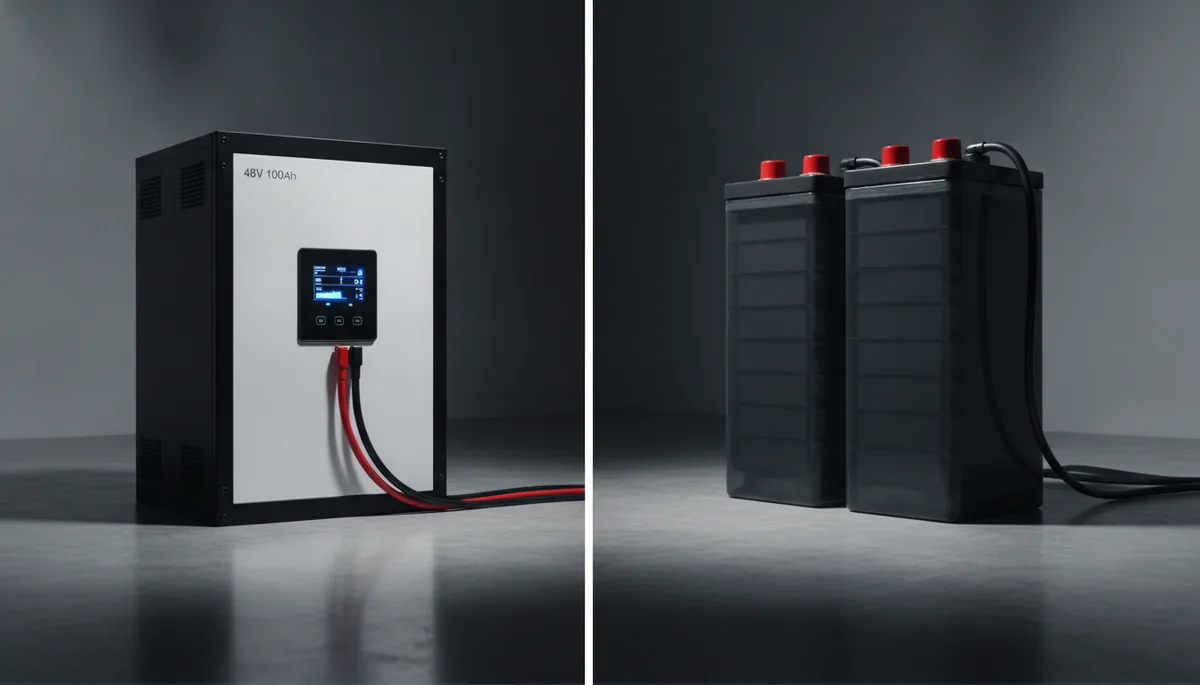
The table below presents an engineering-grade comparison between a standard 48V residential battery bank composed of four 12V 200Ah lead-acid tall tubular batteries versus a single integrated 48V 100Ah (5.12 kWh) rack-mounted Lithium LiFePO4 module.
| Engineering Dimension | 4x 12V 200Ah Tall Tubular Bank | 48V 100Ah (5.12kWh) LiFePO4 Module |
|---|---|---|
| Nominal Energy Capacity | 9.60 kWh (Theoretical Gross) | 5.12 kWh (True Usable Architecture) |
| Recommended Depth of Discharge (DoD) | 50% Maximum (to prevent plate sulfation) | 90% DoD (Guaranteed by active BMS) |
| Actual Real-World Usable Energy | 4.80 kWh | 4.61 kWh |
| Rated Cycle Life (at standard DoD) | 1,000 – 1,200 Cycles | 6,000+ Cycles (15+ Years) |
| Expected Operating Lifespan in Pakistan | 2.0 to 2.5 Years | 12 to 15 Years |
| Round-Trip Energy Efficiency | 72% – 76% (High internal heat losses) | 94% – 96% (Minimal resistance loss) |
| Charging Speed (0% to 90%) | 7 to 9 Hours (Slow bulk/float stages) | 1.5 to 2.0 Hours (1C Fast Charge) |
| Maintenance Requirements | Monthly distilled water top-ups, acid checks | 100% Maintenance-Free Sealed Enclosure |
| Initial Purchase Price (2026 PKR) | Rs. 170,000 – 190,000 | Rs. 270,000 – 310,000 |
3. 5-Year Total Cost of Ownership (TCO) Model in Pakistan
While four tubular batteries cost approximately Rs. 100,000 less upfront than a single 5.12 kWh LiFePO4 module, the economic reality changes radically once replacement frequency is factored into the calculation.
Under Pakistan's typical residential load-shedding profile (1.5 discharge cycles per day), lead-acid tubular batteries exhaust their 1,200-cycle life within 24 to 28 months due to positive plate shedding and active mass disintegration caused by high ambient operating temperatures. In contrast, an authentic Grade-A LiFePO4 battery (such as Narada, Shoto, or Pylontech) operating at 1.5 cycles per day easily operates for over 10 years without noticeable degradation.
5-Year Tubular Battery Total Outlay:
- Initial Purchase (Year 0): Rs. 180,000
- Replacement 1 (Year 2.5): Rs. 210,000 (Adjusted for inflation)
- Replacement 2 (Year 5.0): Rs. 240,000
- Maintenance & Distilled Water (5 Years): Rs. 18,000
Total 5-Year Expenditure = Rs. 648,0005-Year Lithium LiFePO4 Total Outlay:
- Initial Purchase (Year 0): Rs. 285,000
- Replacement Costs (Year 0 to 5): Rs. 0
- Maintenance Costs: Rs. 0
Total 5-Year Expenditure = Rs. 285,000
Net 5-Year Savings With Lithium = Rs. 363,000 (Over 56% Total Cost Reduction!)
4. Extreme Heat Degradation: 45°C+ Operating Realities
In Punjab, Sindh, and Khyber Pakhtunkhwa, battery rooms frequently reach ambient temperatures between 40°C and 46°C during summer months. High ambient heat is extraordinarily destructive to lead-acid electrochemistry. According to the Arrhenius reaction rate rule, for every 10°C increase in operating temperature above 25°C, the internal corrosion rate of lead-acid positive plates doubles, halving calendar life.
Lithium Iron Phosphate, by contrast, possesses inherently stable chemical bonds (the covalent P-O bond in the phosphate crystal lattice). LiFePO4 cells safely operate at sustained temperatures up to 55°C without undergoing thermal runaway or rapid electrolyte breakdown. Built-in Battery Management Systems (BMS) continuously monitor individual cell temperatures using multiple internal NTC thermistors, automatically throttling charge currents if thermal thresholds are approached.
5. BMS Communication Protocols & Inverter Synchronization
A decisive technical superiority of modern Lithium storage is closed-loop communication. Lead-acid batteries are dumb energy reservoirs: the hybrid inverter estimates their state of charge (SoC) based solely on surface terminal voltage, which fluctuates wildly under heavy inductive loads (such as an air conditioner compressor starting).
Modern LiFePO4 batteries feature micro-controlled Battery Management Systems (BMS) communicating directly with the hybrid inverter via Controller Area Network (CAN) or RS485 communication protocols. The BMS transmits real-time telemetry—including exact state of charge (0% to 100%), maximum charge current limits (CCL), maximum discharge current limits (DCL), individual cell voltages, and thermal status—allowing the inverter to regulate charging dynamics with micro-precision. This closed-loop synchronization eliminates overcharging, prevents destructive cell balance drift, and optimizes round-trip energy efficiency.
Optimize Your Energy Storage: Accurately calculate your nighttime battery capacity requirements using our free Solar Load Calculator, evaluate verified battery options in our Batteries Hub, or model your financial savings with the Financial Payback Analyzer.
Frequently Asked Questions: Lithium vs Tubular Batteries (2026)
What is the price of a 48V 100Ah Lithium LiFePO4 battery in Pakistan in 2026?
In 2026, an authentic Grade-A 48V 100Ah (5.12 kWh) rack-mounted Lithium LiFePO4 battery (such as Narada, Shoto, or Pylontech) costs between Rs. 270,000 and Rs. 310,000 with a 5-year official distributor warranty.
Can I replace my old tubular batteries with a Lithium battery on my existing inverter?
Yes, provided your existing hybrid inverter supports 48V DC battery input and features customizable bulk/float charging voltage parameters, or possesses a CAN/RS485 port capable of communicating with a Lithium BMS.
How long will a 48V 100Ah Lithium battery power a 1.5-ton inverter AC?
A 5.12 kWh LiFePO4 battery delivers approximately 4.6 kWh of usable power at 90% DoD. This can power a 1.5-ton inverter AC in energy-saving mode (drawing 900W to 1,100W) for roughly 3.5 to 4.5 continuous hours.
Do Lithium batteries emit hazardous acid fumes during charging?
No, Lithium Iron Phosphate batteries are completely sealed and release zero toxic lead fumes or explosive hydrogen gas, making them safe for indoor installation in apartments, bedrooms, and offices.
How many years does a Lithium LiFePO4 battery last in Pakistan?
At 6,000 cycles, an authentic LiFePO4 battery operating under daily residential discharge cycles provides an engineered service life of 12 to 15 years, outlasting lead-acid tubular batteries by at least five times.
Disclaimer: Battery capacity requirements vary based on continuous inductive appliance surge draws and ambient room temperatures. Consult TechnoKraft engineering personnel for site-specific electrical design and load flow calculations prior to equipment procurement.
Calculate Your Solar Cost — Right Here
Enter your monthly bill to get an instant estimate